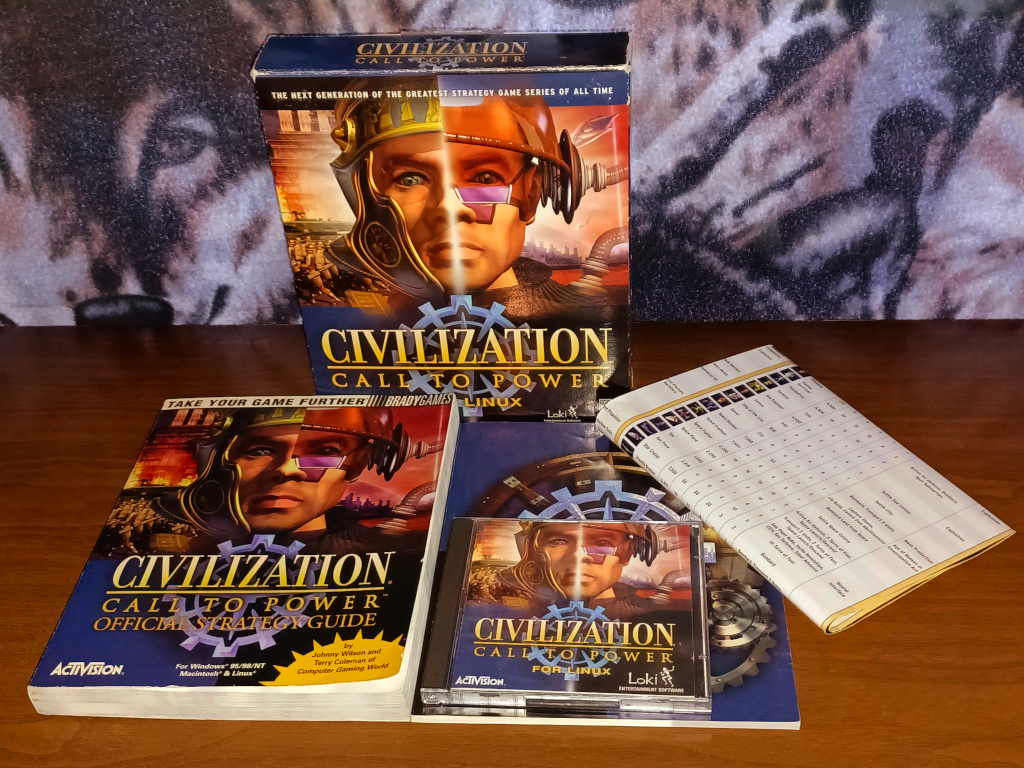
Civilization: Call to Power with the official strategy guide
Civilization: Call to Power is a curious cultural artifact in a number of ways. Developed without accreditation from Sid Meir, the game struggled for legitimacy, taking on a hulking scope and, crucially for us, being ported to as wide a range of platforms as possible, including Linux and even later BeOS. It would be the first port released by Loki Software in May of 1999, and through that, has a claim as the first Linux game ever sold at retail. So many firsts, and yet it remains the black sheep of the family.
Even among Loki Software's other offerings Call to Power stands out, with it not using the standard Loki Setup tool, but rather one that more closely emulates the look of the installer on Windows, displaying concept art as it progresses. Freeciv was very much a thing by this point, so Call to Power did have to stand out with its presentation, showing off lavish cinematics that again required Loki Software to develop their own bespoke tools which they would continue to refine going forward.
Call to Power does struggle in other areas though, with much of the game being abstracted behind staid menus and prompts, from building up cities to talking to other nations. The result is a cumbersome user interface that buries important information, with big events such as wiping out a rival power only being heralded by unremarkable icon notifications. A tutorial is included to help wrap your head around all this, but even the game's predecessors managed to appear more engaging than this.
Starting a new game with just the defaults, I took charge as Julius Caesar of the Romans. I waged a swift campaign against the Russians, but from there my futures would begin to diverge. The Greeks were also making war on me, and being my weakest rival, I decided to march on them next. Doing this angered the Nicaraguans, with whom the Greeks had good relations, leaving me challenged from all sides. Feeling this was untenable, I loaded a prior save and opted for a more diplomatic approach.
The Nicaraguans were at war with the Portuguese, and exploiting this fact, I joined them in their crusade. This caused them to propose an alliance, which I accepted, making modest gains before the Portuguese sued for peace. I then wheeled around and curb stomped the Greeks, with their Nicaraguan protectors now sworn not to attack me. It was from here that I became stymied. I attempted to be a good ally, rejoining the fight with the Portuguese, but the Nicaraguans always left me in the dust.
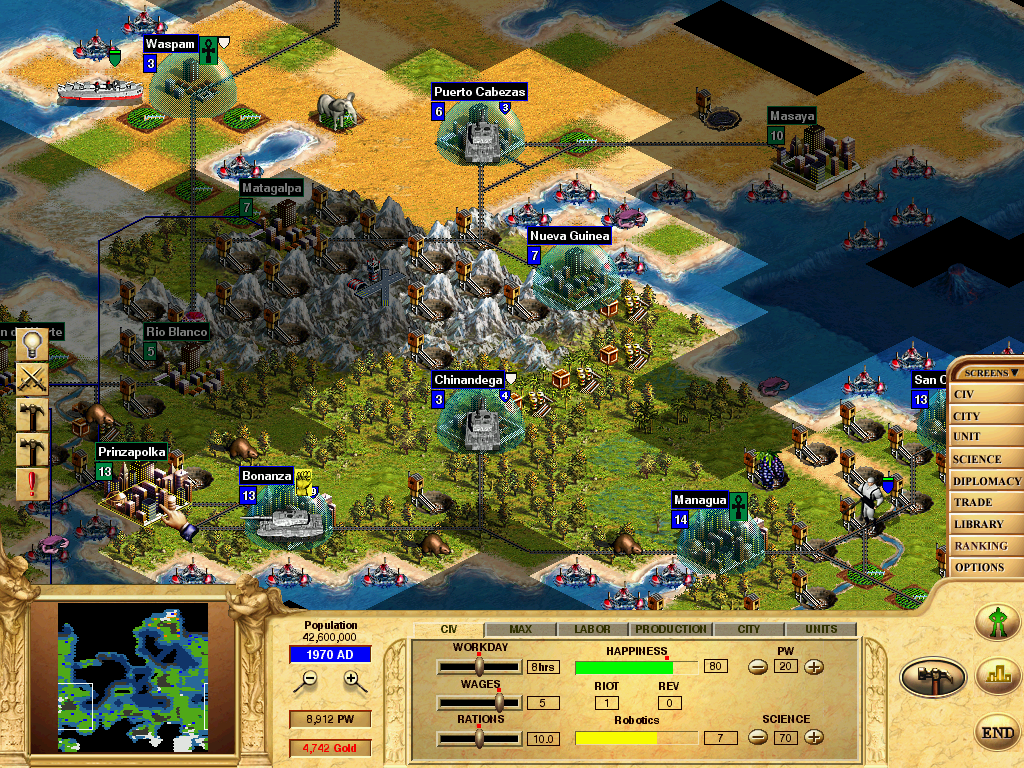
No matter what I tried, including sending spies to steal their advancements using all of the gold that they paid me, their lead in both score and overall development became unassailable. In the end I had to go back to just after I took out the Greeks again, and betray my ally early before they got too far ahead. Pitched battles followed, but I ended the war victorious and unmatched. The sequel does allow for an allied victory, but here, peace was never an option it seems.
And then the game froze after displaying the victory through conquest cinematic. Patching it from 1.1 up to the final 1.2 update resolved this, but did introduce a new issue where the game will crash if left playing the opening cinematic. I also found myself being kicked to the desktop throughout, encouraging me to save often, and perceived the CD music toggling to be inconsistent. Loki also bolted on extra multiplayer modes, as well as putting out a sprite editor and installers for switching languages.
Ultimately I did play through the game three times, including with the Loki created example scenario, and every time I was left feeling that it was uneven. Fair or not, I found myself feeling hostile to most of the more futuristic additions, especially since the past feels abridged so they could cram more of them in. Call to Power is full of gimmicks that do more to distract than enrich the Civilization experience, as fun as blasting lawyers with battle mechs can prove to be, leaving the game lopsided.
Futurology rapidly becomes dated, and the game is a bit too enamoured with too many turn of the millennium preoccupations for my taste. The biggest systemic change is the addition of sea and space colonies, causing the map to be split over two views and three zones in later ages, but I always managed to wrap things up before the game got too far into all of this. I would have preferred a custom rule to cap things at the modern day, but the developers did insist on you playing with their new toys.
Some changes I do like, such as the ability to stack up to nine units and see them engage the enemy through an accompanying battle screen, as well as the way the game deals with public works. Call to Power does have a solid core underneath all of the frippery, and did manage a follow up, titled as just Call to Power II after the Civilization rights returned to Sid Meir and company. This too would come to Linux after its source code was released in 2003, under the "Apolyton Edition" label.

Hamish Paul Wilson is a free software developer, game critic, amateur writer, cattle rancher, shepherd, and beekeeper living in rural Alberta, Canada. He is an advocate of both DRM free native Linux gaming and the free software movement alongside his other causes, and further information can be found at his icculus.org homepage where he lists everything he is currently involved in.
You can use your Fediverse (including Mastodon, among many others) account to reply to this post. You can also follow my Mastodon to be notified when new parts of this series are released.
An archive of the Loki Software product page for Civilization: Call to Power can be found here:
https://www.lokigames.twolife.be/products/civctpThe Linux Game Tome entry for Civilization: Call to Power is archived here:
http://www.happypenguin.org/show?Civilization%3A%20Call%20To%20Power&showall=1#commentsA review of the game for Linux by Heather Grove for Errant Dreams can be read here:
https://www.errantdreams.com/2006/06/civilization-call-to-power-for-linuxA review of the game for Linux by Rawn Shah for LinuxWorld is archived here:
http://linuxworld.com/linuxworld/lw-1999-06/lw-06-civilization.htmlA review of the game by Aron Hsiao for About.com is archived here:
http://linux.about.com/compute/linux/library/weekly/aa071999c-a.htmA review of the game by Steve Coe for CanadaComputes.com is archived here:
http://olscms01.canadacomputes.com/v3/story/1,1017,790,00.htmlA review of the game by Jeremy Katz for linuxpower.org is archived here:
http://linuxpower.org/display_item.phtml?id=119A review of the game by James Brief for Handeye.com is archived here:
http://www.handeye.com/civ.php3A preview of the game by Jeff Alami for 32BitsOnline.com is archived here:
http://www.32bitsonline.com/article.php3?file=issues/199905/civctp/civctp-&page=1A review of the game by Michael J. Hammel for Linux Journal can be read here:
https://www.linuxjournal.com/files/linuxjournal.com/linuxjournal/articles/035/3521/3521s1.htmlAnd a period interview with Loki Software by Michael J. Hammel for Linux Journal can be found here:
https://www.linuxjournal.com/article/3521
Licensed under Creative Commons Attribution-ShareAlike 4.0 International (CC BY-SA 4.0)